
Comfort Kamogelo Mamabolo: Telling Stories in the Language of His Ancestors
For Comfort Kamogelo Mamabolo, language is more than a means of communication. It is a bridge between generations, a repository of memory, and a tool for preserving stories that might otherwise be forgotten.
The 28-year-old translator, linguist, poet, scriptwriter, visual artist, YouTuber, and student journalist hails from GaChuene’s Thokgwaneng village outside Polokwane in Limpopo. His passion for storytelling and documenting history has shaped a creative journey that spans literature, education, visual art, and digital media.
Mamabolo graduated from the University of Limpopo in 2022 with a BA degree in Translation, Interpreting and Linguistics. Since then, he has continued to build an impressive body of work while pursuing a Master’s degree in Linguistics at the same institution.
His literary journey began with the writing of his first Northern Sotho (Sepedi) book, Ke Bofsa. He later became a co-author of several publications exploring themes related to indigenous South African languages and cultural heritage, including Se di gadikele go di phura, Tsamatlogadibesong, Nthole tse boima, and Krotoa.
Beyond the written page, Mamabolo is passionate about making language accessible to wider audiences. Through his YouTube channel, he teaches Sepedi to learners online, while his social media presence also showcases his creativity through humorous content and cultural commentary. He is currently a student journalist for Keyaka Magazine, further expanding his commitment to storytelling and documentation.
Giving Voice to Forgotten Histories
Among the books Mamabolo has contributed to, Krotoa holds special significance. Named after the Khoisan historical figure whose life remains one of the most debated and symbolic stories in South African history, the book allowed him to explore a culture that has long fascinated him.
“I am fascinated by Khoi culture and how the world came to be what it is today,” says Mamabolo. “The history of Jan van Riebeeck and Africans motivated me to do research, and that is how I came across the name Krotoa.”
His contribution to the publication was driven by a desire to bring overlooked stories into the spotlight.
“What motivated me to write about Khoi culture was my desire to give voice to stories that are often left out of mainstream history,” he explains. “I chose to focus on the Khoi people because I was fascinated by their deep connection to the land, their language, and their knowledge that has been passed down for generations.”
For Mamabolo, engaging with Khoi history was not merely an academic exercise. It became an opportunity to encourage young South Africans to embrace the country’s diverse cultural heritage.
“As a young South African, I believe it’s important for us to learn about all the cultures that make up our country, not just the ones we hear about every day,” he says. “Writing about the Khoi reminded me that heritage is not only about our history, but also, respect, resilience, and how to live in harmony with nature.”
He hopes that his work will inspire curiosity among younger generations.
“I want my contribution to the book to encourage other young people to be curious about their roots and to take pride in the diverse cultures that shape who we are as South Africans.”
The Power of Writing in Sepedi
Much of Mamabolo’s literary work is grounded in his commitment to writing in his mother tongue. In an era increasingly dominated by English and digital technology, he believes indigenous languages remain essential to preserving identity and culture.
“I believe our native languages are the heartbeat of who we are,” he says.
“In a world moving fast with technology and English, it is still important for writers to use their mother tongue so that our culture, proverbs, and ways of thinking are not lost.”
For Mamabolo, writing in Sepedi allows him to communicate emotions and ideas with a depth that translation alone cannot always achieve.
“When I write in Sepedi, I can express emotions and ideas that don’t translate the same way in English. My words reach people in my community who may not be comfortable with English, and it reminds them that our language is valuable and modern, not old-fashioned.”
While he acknowledges the importance of English as a global language, he sees multilingualism as the way forward.
“English helps us connect globally, but Sepedi helps us connect to our roots. By writing in both; me in Sepedi, others in English; we prove that technology and tradition can go together. The future is digital, but it should also be multilingual.”
Poetry, Faith and Visual Storytelling
Mamabolo’s creativity extends beyond prose. In the anthology Se di gadikele go di phura, his poem Re neilwe maatla a sefapano (We Are Mighty Through the Power of the Cross) invites readers into a moment of spiritual reflection. The poem serves as both a reminder and a reassurance that strength can be found through faith.
His artistic expression also takes visual form. One of his collage artworks, Tree of Hope, was featured at the Polokwane Art Museum. The work encourages unity and collective hope, themes that frequently emerge across his creative practice.
Whether through poetry, visual art, journalism, teaching, or literature, Mamabolo’s work is united by a common purpose: preserving stories, celebrating culture, and ensuring that indigenous knowledge remains visible in contemporary society.
To follow Mamabolo’s journey as a writer, linguist, educator, and artist, readers can find him on social media, where he regularly shares his creative work, teaches Sepedi, and celebrates the richness of South Africa’s linguistic and cultural heritage. http://www.youtube.com/%40SEPEDIMENTOR, https://www.facebook.com/Moanegathwadi/ TikTok
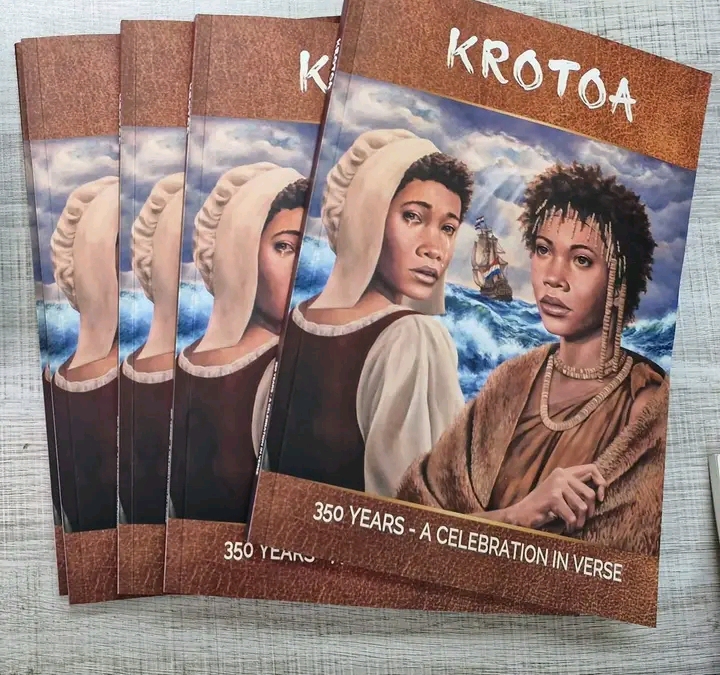
Krotoa
– C.K. Mamabolo
Genre: Anthology
Available for pre-order now.
Upcoming Events